Why Rolling Queues Don’t Deliver Fair Games
Why is it that a simple rotation system isn't as effective at ensuring fair play? We run the numbers and explain why a better system is needed if you want to ensure there is a good mix of playing partners at a session.

At many clubs, the aim is simple: make sure everyone plays a fair number of games against a variety of different players. That way, people don’t get “stuck” with the same partners, and newer players get a chance to mix in with everyone else.
Recently, some clubs have tried using a Rolling Queue system. On paper, it sounds straightforward: after each game, winners go into a winners’ queue, losers into a losers’ queue, and the next four players are picked from whichever queue is due. Everyone gets a turn in order, so it feels fair… right?
We tested this with simulations to see what really happens when you use Rolling Queues over an evening of games.
The Problem with Rolling Queues
The fundamental issue is that Rolling Queues only care about “who’s next in line” – not about who players have already played with or against. That means:
- Players often end up repeating games with the same partners or opponents.
- Some players hardly ever meet certain others, even across a whole session.
- Variety suffers because the system doesn’t track who you’ve already played.
In other words, it keeps things moving, but not balanced.
What we did
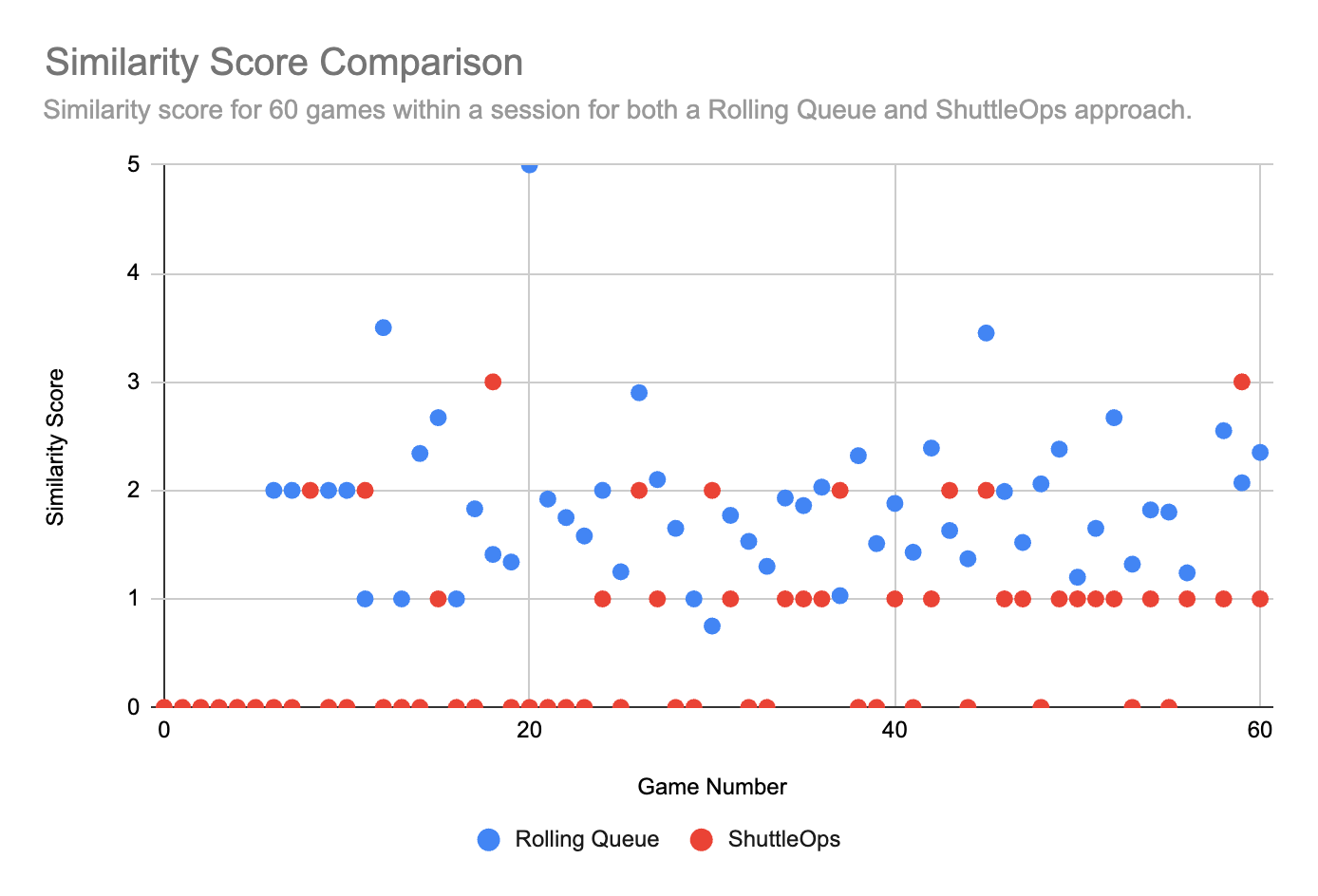
To understand the difference we ran a simulation with 22 players across 4 courts, covering 60 games. Each game was simulated to last between 8 and 12 minutes to introduce variability about who becomes available when games finish. We ran one simulation using the Rolling Queues approach, and the second simulation using the ShuttleOps approach. With each game that is created we calculate a similarity score. This measures how much overlap exists between the players in the current game and their past playing history. The higher the score, the more the current lineup reflects familiar pairings between players.
Think of it as a metric that answers:
👉 “Have these players teamed up a lot before, or is this a fresh mix of faces?”
A high similarity score indicates players are often grouped together—could highlight strong existing cliques or consistent team compositions.
In contrast, a low similarity score suggests a fresh or experimental lineup, potentially mixing players who haven’t interacted much.
This metric is useful for understanding patterns in team dynamics, fairness in matchmaking, or even just spotting when a lineup is unusually familiar.
When running the simulations we also kept track of how many times a player has played with another individual on the same court. Similarly we can see how many players an individual hasn't played with. These are both indications of how much variation there is in the games.
What the Data Shows
Here’s what the data revealed:
- With the rolling queue system some players played with the same person up to 8 times in one evening.
- On average the 22 players played with 16 of them via the rolling queue system, but 19 of them via the ShuttleOps approach.
- Within the first 12 games, the total similarity score for the rolling queue system was 14.5, while for the same period using the ShuttleOps approach it was only 4.
- Games themselves became increasingly repetitive, with high levels of overlap in who was on court together.
- The average similarity of the rolling queue system was 1.7, compared to an average score of 0.67 via ShuttleOps.
So while everyone did get on court regularly, the “mixing” wasn’t happening as intended.
What the Data Doesn't Show
This approach is good for being able to repeat the scenarios multiple times easily and while it produces repeatable metrics, one thing it doesn't show is the gender balance. With the rolling queue approach these games will be a mix of all men, all women, or either a 3/1 or 2/2 mix. In contrast ALL of the games with the ShuttleOps approach will be balanced to ensure the games aren't 'wonky', with a 3/1 mix of genders, and it'll be applying consideration to the skill value entered on the players profile.
This detail isn't as easy to track as number of games played for example, but makes a massive difference to the enjoyment of a session. Players can often feel out of place if the balance of the players is not right and this in turn leads to dissatisfied members who are not able to reach their potential as the quality of the games isn't right.
This approach has been run with 22 players and 60, but the reality is that with less players and less games the difference between the systems is exaggerated. For example with 19 players and 40 games, the average number of different players played with drops to 9.3 with the Rolling Queue approach. After 12 games, the similarity score total was also already over 30!
Why It Matters
Badminton is more fun when:
- You play against a wide range of players.
- You’re not stuck with the same partner over and over.
- Everyone feels included, not just those who happen to fall into the right queue order.
- Games are balanced - both in terms of gender and skill level
Rolling Queues don’t guarantee this. They simply recycle players in a strict order, without looking at who they’ve already played with. That’s why the games start to feel repetitive, even if they look fair at a glance.
A Smarter Alternative
Instead of just picking “who’s next,” a smarter approach looks at:
- Who hasn’t played recently (so no one waits too long).
- Who hasn’t played together yet (to maximise variety).
- Balancing partners and opponents (so games feel fairer).
This is the thinking behind the digital peg board in ShuttleOps. It makes sure players are rotated fairly, giving everyone a better mix of partners and opponents over the course of an evening.
The Bottom Line
Rolling Queues may look simple, but simplicity comes at a cost: less variety, more repetition, and fewer opportunities to play with everyone at the club.
A system that actually tracks player matchups gives a fairer, more enjoyable experience – one where everyone really does get the chance to “play everybody.”